



How Generative AI Is Transforming Website Content Creation: Text, Images, Video, and Visual Editing
 Oct 11,2026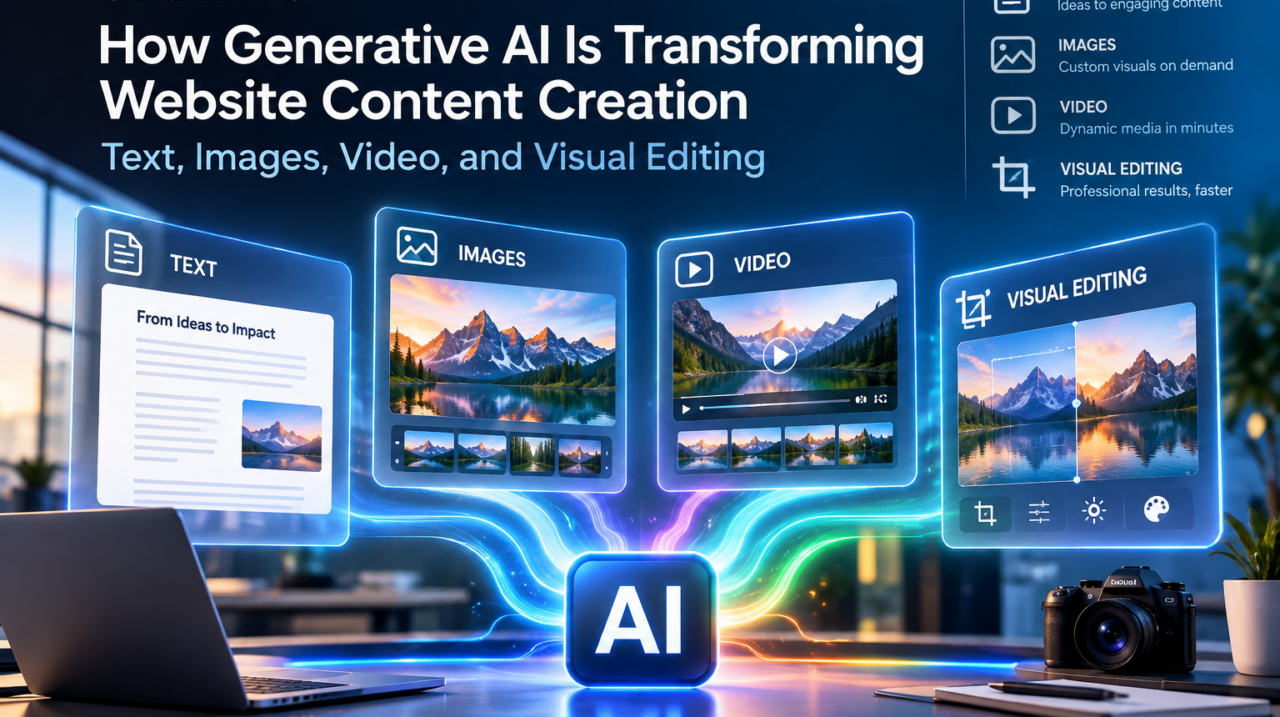
Generative AI is changing website publishing from a sequence of separate writing, design, and media-production tasks into a more integrated editing workflow. Instead of moving between a text generator, an image service, a video application, and a website builder, teams can increasingly generate and refine content where it will actually appear.
That shift matters technically. Producing an acceptable paragraph or image is only one part of the process. The more demanding requirement is connecting AI output to the correct website control, preserving the editor’s state, and allowing the author to review and revise the result before publication.
From standalone generation to integrated content workflows
Early AI-assisted publishing often followed a copy-and-paste model. A user wrote a prompt in one application, copied the result, and returned to the website editor. For text, this approach was manageable. For images and video, it introduced file transfers, naming decisions, media-library uploads, and repeated editing steps.
Integrated AI workflows reduce that friction by associating generation with a specific content destination. A heading field needs a concise title; a rich-text field may need multiple paragraphs; an image control requires a media asset and its metadata. The application must understand these distinctions before it inserts any result.
GridWrite AI represents this approach through AI controls embedded in the website editing workflow. The emphasis is on generating content for the selected control rather than requiring the user to manage a disconnected generation session.
1. Text generation is a structured editing problem
Large language models generate text by processing prompts and predicting sequences of tokens. Their output can be useful for headings, introductions, descriptions, button labels, and long-form sections, but the same prompt structure is not appropriate for every destination.
A heading generally needs a defined length and clear subject. A button label needs to describe an action. A product description may require a factual specification set, while editorial content needs a coherent argument and an appropriate tone. Context-aware generation can improve the usefulness of each result by considering the control’s purpose.
Equally important is insertion behavior. If a generated heading appears on a published page but not in the live editor, the author sees inconsistent state. A dependable integration must update the underlying control value and the preview together, while retaining ordinary editing and undo behavior.
2. AI images introduce asset-management requirements
Image generation produces a file rather than a text string. Once generated, that asset must be stored, associated with the correct website field, and retrieved reliably. Image format, dimensions, filename, alternative text, and caching behavior all become part of the workflow.
There is also a distinction between generating a new image and replacing the content of an existing image control. A replacement should update the actual media reference instead of merely overlaying an image visually. Otherwise, an editor refresh or page reload can reveal an old placeholder or stale media selection.
Website performance remains relevant. Large images may improve visual impact but increase transfer size and decoding work. Appropriate sizing, compression, responsive image delivery, and content-delivery caching help prevent visual generation from undermining page speed.
3. Video generation requires asynchronous workflows
Video is more demanding than text because generating and processing a clip can take significantly longer than producing a short written passage. File sizes and storage requirements are also higher.
An effective workflow therefore separates the initial request from the completed asset. The interface should report whether the operation is pending, processing, complete, or failed. Once the video is ready, it can be added to the media library or associated with a supported video control.
Applications also need to account for retries, incomplete jobs, and potentially higher service costs. A browser interface should not imply success merely because a generation request was accepted.
4. Widget controls and repeaters add complexity
Modern page builders commonly represent a website as a hierarchy of sections, containers, widgets, and controls. Some controls are simple values such as a heading or button label. Others hold media objects, formatted text, or arrays of repeated items.
A carousel illustrates the challenge. Each slide may contain a title, description, image, and button. An AI operation intended for one slide must not overwrite another. Generating several slides at once requires a reliable mapping between generated values and individual repeater rows.
Schema-driven control discovery can help identify eligible text and media fields without building a bespoke AI workflow for every widget. However, highly specialized controls may still require dedicated handling. The goal is broad compatibility without sacrificing predictable editor behavior.
5. The application state must remain authoritative
Content generation is not complete when the model responds. The real completion point is when the website editor has accepted the result into its data model and the user can see the change.
This distinction helps explain common integration failures: an image appears temporarily but reverts on refresh, a text field updates only after a manual keystroke, or the editor redraws repeatedly after a new asset is inserted. These problems concern state synchronization and component lifecycle management rather than the quality of the AI output.
Using the editor’s supported update mechanisms, preserving item context, and checking the final stored value are more dependable than manipulating visual elements alone.
6. Human review remains part of the publishing pipeline
Generative models can accelerate first drafts and creative exploration, but they do not independently guarantee accuracy or suitability. Editorial review is especially important for technical specifications, legal or financial claims, customer-facing commitments, and information that changes frequently.
Image and video output should also be evaluated for brand consistency, licensing considerations, accessibility, and realistic representation. A practical workflow lets editors revise generated work rather than forcing an automatic publish step.
For search visibility, technical fundamentals still matter: descriptive headings, meaningful page content, internal links, accessible image descriptions, appropriate structured data, and fast loading. AI can assist with content production, but it does not replace those foundations.
7. Cost, permissions, and provider flexibility
Text, image, and video services can have different usage models. Token counts, output size, generation duration, and service-specific pricing all influence operating costs. Site-level limits and reporting help teams understand consumption and avoid unexpectedly expensive workflows.
Credentials should be handled server-side, and access to generation tools should respect the user’s editing permissions. A visitor who can read a page should not automatically gain permission to generate media or modify its content.
Separating provider configuration and usage governance from individual editing operations also makes it easier to evolve the system as models and service offerings change.
8. What integrated AI means for website production
The long-term opportunity is not simply faster content generation. It is a more consistent production process: select a website control, generate an appropriate result, apply it safely, review it visually, and continue editing.
That pattern can support different website technologies and content systems, even though their editor APIs and component models vary. A traditional content management system and a hosted visual builder may implement the steps differently, but they share the same objective: preserving accurate content state while reducing manual production work.
With GridWrite AI, the central idea is to bring text, image, video, and repeated-item generation into the website workflow. The technical value comes from the integration between AI services and editing controls—not from treating generated output as a separate destination.
As AI becomes a routine part of website production, reliable editor integration, transparent usage controls, and human review will matter just as much as model capability.