



How AI Chatbots Use Knowledge Bases, Embeddings, and Language Models to Deliver Contextual Answers
 Oct 11,2026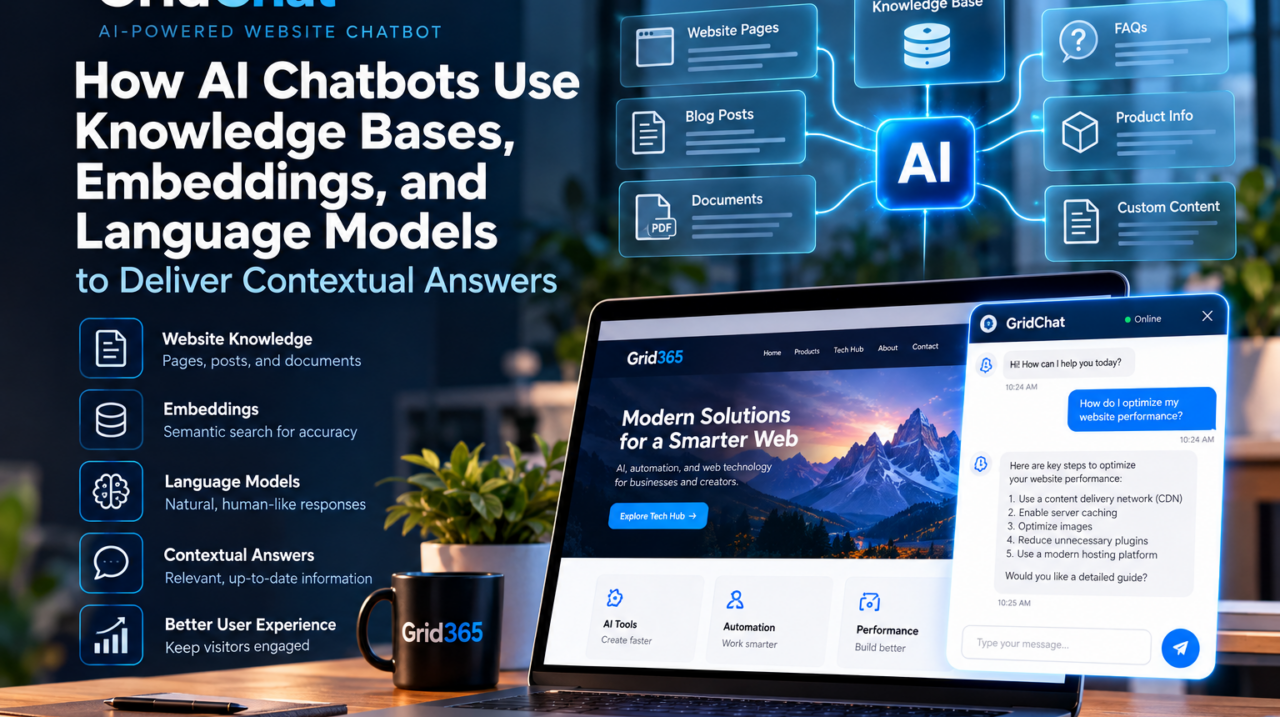
Modern website chatbots are more than scripted question-and-answer interfaces. When connected to an approved website knowledge base, an AI assistant can retrieve relevant information and compose a conversational response grounded in the site’s actual content. That capability depends on a technical pipeline combining document preparation, embeddings, semantic retrieval, and language-model generation.
From predefined answers to retrieval-augmented generation
Traditional chat widgets use decision trees or manually entered responses. They can be predictable, but require constant maintenance as site information changes. A retrieval-augmented generation (RAG) system takes another approach: it searches the site’s knowledge content for passages relevant to the visitor’s question, then supplies those passages as context to a language model.
This is an important distinction. The model is not necessarily being trained on each website’s material. Instead, the application retrieves site-specific context at request time. This makes updates to the knowledge base more practical and allows citations or links to source pages where appropriate.
1. Preparing the knowledge base
A website contains diverse information: service pages, blog posts, FAQ entries, product descriptions, and sometimes uploaded documents. Before these sources can be searched effectively, the application must extract readable text, normalize it, and divide it into manageable sections.
Chunk size matters. Overly large chunks may dilute relevance and increase prompt size, while excessively small chunks can lose important context. Document titles, page URLs, and content identifiers should travel with each chunk so retrieved information can be traced to its source.
Site operators also need control over what is indexed. Drafts, private pages, outdated policies, and irrelevant administrative content should not automatically become public chatbot answers. A disciplined ingestion process respects publishing status and access permissions.
2. What embeddings actually do
An embedding model converts a piece of text into a numeric vector that represents aspects of its meaning. Related expressions can occupy nearby regions of this vector space even when they do not share the exact same words.
For example, a visitor asking “Can I change my reservation?” might be matched with a page titled “Booking modifications.” Keyword-only search can miss such phrasing differences. Semantic similarity can help find the more relevant passage.
Embeddings are usually generated when content is indexed. The visitor’s incoming question can then be embedded using a compatible model, and a similarity search can identify potentially useful text chunks. Embeddings improve retrieval, but they do not prove that a retrieved statement is accurate or current.
3. Retrieval quality is critical
A chatbot can produce a fluent answer from poor context. Search quality therefore matters as much as the language model itself. Retrieval pipelines may rank candidate passages using vector similarity, keyword matching, metadata filters, or combinations of methods.
Effective systems also establish a threshold for relevance. If the knowledge base does not contain an answer, the assistant should acknowledge the limit rather than inventing a policy or service offering. Restricting answers to authorized site material is especially important for customer-facing applications.
Content updates create another operational challenge: changed pages must be reindexed, removed documents should cease to appear in results, and duplicate chunks should be managed to avoid noisy responses.
4. The language model turns context into conversation
Once relevant passages are selected, the application assembles a prompt containing instructions, the visitor’s question, and retrieved context. The model then generates a response intended to answer the question within those boundaries.
This stage benefits from concise prompts, context size limits, and explicit behavior for uncertain answers. The assistant may supply a link to the source page when it genuinely helps the visitor continue. A link to the home page after every response is less useful than a targeted reference to a relevant service or support article.
Conversation history adds continuity but increases token usage and privacy considerations. Applications should determine how much history is retained, how it is summarized, and how a new question is separated from outdated context.
5. Website integration and visitor experience
A floating chat widget needs to work consistently across page navigation, responsive layouts, and different browsers. Preserving an active conversation as visitors move through a website reduces friction, but requires deliberate session state management.
The front end should clearly distinguish the visitor’s messages from the assistant’s replies, show request status, handle failures, and provide an obvious way to restart a conversation. Feedback controls can help operators evaluate usefulness, although positive reactions alone do not demonstrate factual correctness.
GridChat focuses on website-based knowledge and visitor assistance, illustrating a practical implementation of this architecture. Its value is in connecting conversational AI with approved site information rather than presenting a general-purpose chatbot with no local context.
6. Security, privacy, and prompt injection
Knowledge-base text must be treated as untrusted content. A retrieved document may include malicious instructions that attempt to override the assistant’s rules. Separating source data from application instructions is essential.
Other safeguards include permission checks, request validation, usage controls, limited retention, and careful treatment of personally identifying information. Site administrators should be able to determine which sources the assistant may use and should avoid indexing sensitive documents without an explicit access model.
Rate limits and usage monitoring help protect against automated abuse. Because embedding operations and conversations can both incur model costs, accounting should distinguish between indexing and visitor interactions.
7. Measuring quality beyond chat volume
Useful evaluation metrics include answer relevance, groundedness, retrieval precision, response latency, fallback frequency, and whether visitors reach an appropriate next step. Tracking only the number of conversations can reward activity without measuring successful assistance.
Test questions should cover straightforward facts, ambiguous wording, information absent from the site, and content recently updated. Operators should review examples of unsupported answers and improve the knowledge base or retrieval settings accordingly.
Where website AI assistance is heading
Knowledge-grounded AI assistants can make website information easier to access, particularly on sites with large service catalogs or extensive documentation. Their reliability depends on sound ingestion, meaningful retrieval, explicit security boundaries, and clear handling of uncertainty.
The key architectural lesson is that a useful chatbot is not simply a language model placed behind a chat bubble. It is a coordinated knowledge system in which source content, search infrastructure, model behavior, and visitor experience must work together.